

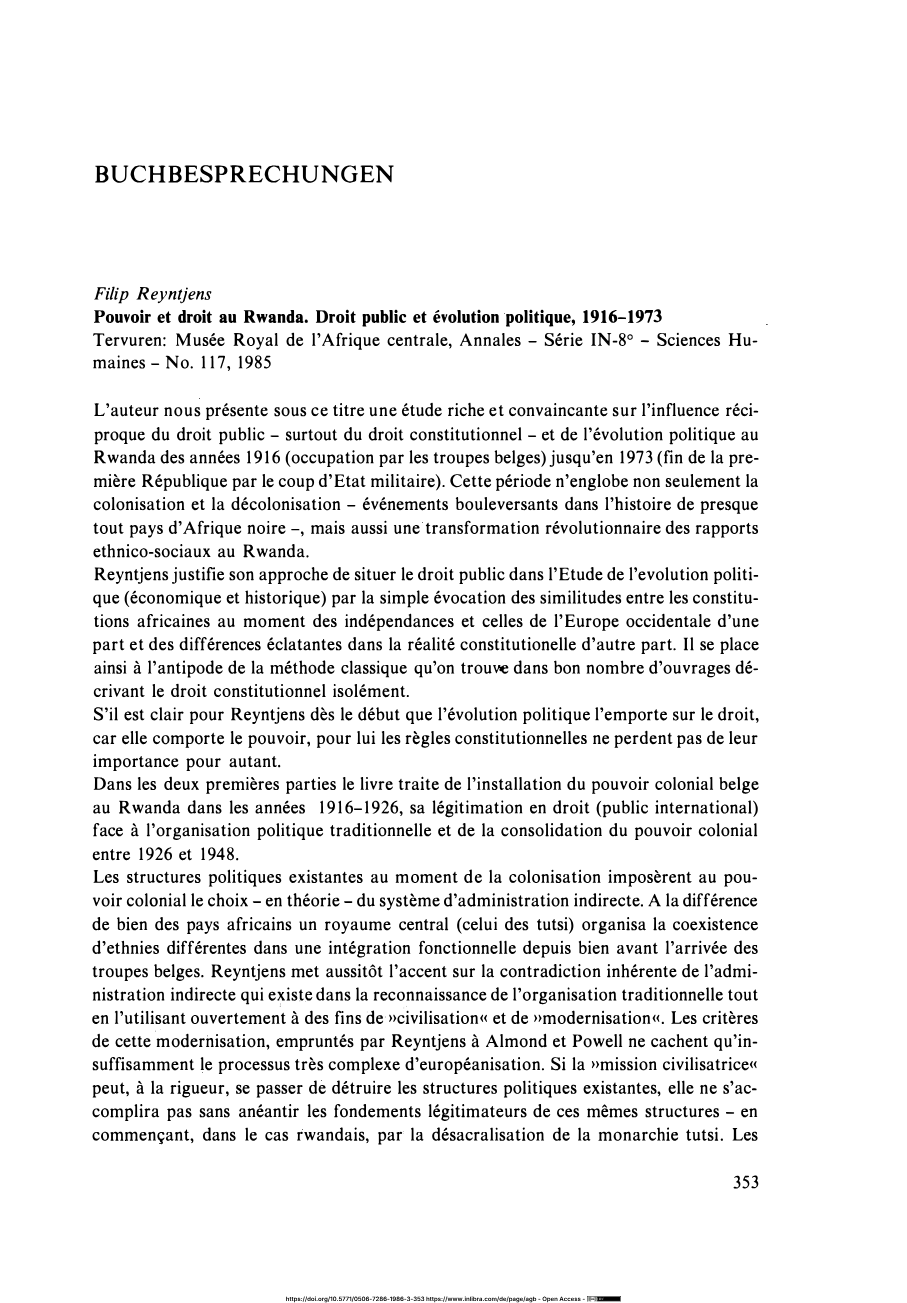
Cette recension examine l’ouvrage de Filip Reyntjens sur l’influence réciproque du droit public et de l’évolution politique au Rwanda entre 1916 et 1973. La période étudiée couvre la colonisation, la décolonisation et des transformations ethnico-sociales majeures, offrant une perspective critique sur les approches classiques du droit constitutionnel. L’auteur analyse l’installation du pouvoir colonial belge, sa légitimation juridique, la consolidation de ce pouvoir, et les dynamiques socio-politiques menant à l’indépendance. Il décrit l’élaboration et le fonctionnement de la première République rwandaise, soulignant le rôle de l’administration coloniale et de l’Église dans le transfert de pouvoir. Les conclusions révèlent une évolution vers un présidentialisme autoritaire et la fragilisation des institutions, souvent attribuée au legs colonial. L’ouvrage met en lumière la complexité des dynamiques post-coloniales et l’importance d’une constitution comme rempart psychologique contre l’autoritarisme.
This review examines Filip Reyntjens’ work on the reciprocal influence of public law and political evolution in Rwanda between 1916 and 1973. The period studied covers colonization, decolonization, and major ethno-social transformations, offering a critical perspective on classical approaches to constitutional law. The author analyzes the establishment of Belgian colonial power, its legal legitimization, the consolidation of this power, and the socio-political dynamics leading to independence. He describes the elaboration and functioning of the first Rwandan Republic, highlighting the role of colonial administration and the Church in the transfer of power. The findings reveal an evolution towards authoritarian presidentialism and the weakening of institutions, often attributed to the colonial legacy. The work sheds light on the complexity of post-colonial dynamics and the importance of a constitution as a psychological bulwark against authoritarianism.
Share with my friend :

Avis
Il n’y a pas encore d’avis.