

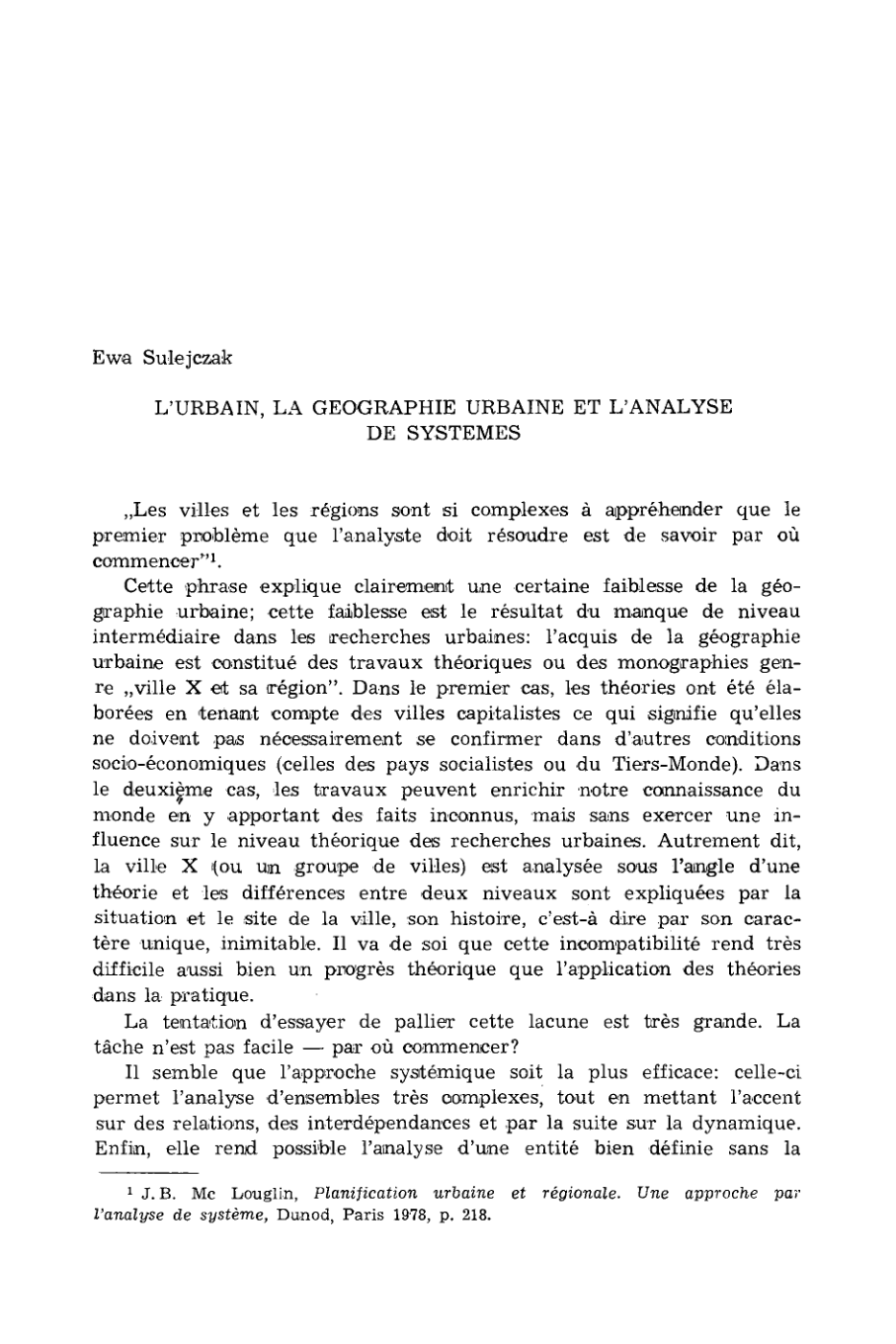
Cet article critique la géographie urbaine pour son manque d’analyse intermédiaire entre théories générales et monographies, ce qui freine le progrès théorique et l’application, notamment pour les villes des pays en développement. Pour pallier cette lacune, l’étude propose une approche systémique, jugée efficace pour analyser des ensembles urbains complexes. Cette méthode conçoit la ville comme un système ouvert, évolutif et spatial, axé sur les relations, interdépendances et dynamiques. L’auteur identifie des convergences entre économistes, sociologues et géographes sur des phénomènes urbains comme les effets externes et la diffusion des innovations. L’apport principal est d’encourager une collaboration interdisciplinaire théorique, essentielle pour une compréhension holistique de la ville et de sa spatialisation, face à l’intervention étatique croissante en aménagement urbain.
This article criticizes urban geography for its lack of intermediate analysis between general theories and specific monographs, hindering theoretical progress and practical application, especially for cities in developing countries. To address this gap, the study proposes a systemic approach, deemed effective for analyzing complex urban systems. This method conceives the city as an open, evolving, and spatial system, focusing on relationships, interdependencies, and dynamics. The author identifies convergences among economists, sociologists, and geographers on urban phenomena such as external effects and innovation diffusion. The main contribution is to encourage theoretical interdisciplinary collaboration, essential for a holistic understanding of the city and its spatialization, given increasing state intervention in urban planning.
Share with my friend :
![[Bourse de recherche - Juillet 2025] CORAF pour la résilience des systèmes alimentaires en Afrique de l'Ouest](https://ilminlibrary.com/wp-content/uploads/2025/06/1750245283076-300x300.jpg)
![[Research Funding] CODESRIA : Meaning-making Research Initiatives (MRI) 2025](https://ilminlibrary.com/wp-content/uploads/2025/02/Call-MRI-General-2025_English_Final-pdf.jpg)
Avis
Il n’y a pas encore d’avis.